On April 21, Ashley Delaney brought his father-in-law to the Goa Medical College and Medical facility, the biggest public medical facility in the little southwestern Indian state. The healthcare facility remained in turmoil and the wards were loaded, with all 708 covid beds inhabited– so 69- year-old Joseph Paul Alvares, a cancer survivor, needed to rest on a gurney for almost 3 days for a bed to appear. The restrooms were so dirty that numerous clients picked to use adult diapers. And when one covid-positive guy established seizures, the medical facility personnel– apparently not able to cope– connected him to the bedposts with plasters. Delaney was so disrupted by what he saw that he chose to remain by his father-in-law’s side in case things deviated for the even worse. Quickly enough, they did.
On the early morning of April 28, numerous clients’ screens began to flash and show that they remained in distress, however the medical facility personnel didn’t react. When Delaney visited examine, he saw that the clients– around 10 to 12 of them, as he later on remembered– had actually passed away. He wasn’t a physician, however it appeared there had actually been an issue with the oxygen materials. Delaney notified numerous nurses and physicians, who informed him that they had actually currently grumbled to the administration however had actually been dismissed. On May 2, the event duplicated itself. This time 12 clients passed away. On May 3, the number who passed away that night increased to14 Delaney observed that in each case, a drop in oxygen had actually happened in between 2 a.m. and 6 a.m. It appeared to him that oxygen products were going out night after night, triggering clients to asphyxiate.
On May 4, after Delaney had actually been observing the covid wards for almost 2 weeks, a whole ward lacked oxygen. He saw an opportunity to conserve everybody impacted– all the clients were still alive, though having a hard time– however when he approached personnel, they confided that they hesitated of reprisals from the medical facility administration if they raised their voices. After 2 clients passed away, he went public with his findings.
Delaney, a 39- year-old IT specialist, currently had a fondness for advocacy. At the start of the pandemic, he had actually provided important products to migrant employees. He employed his other half, a designer, to make protective masks, which the couple dispersed totally free to frontline employees. Now he relied on the exact same location where other desperate, internet-savvy Indians were looking for assistance throughout the frustrating 2nd wave: social networks.
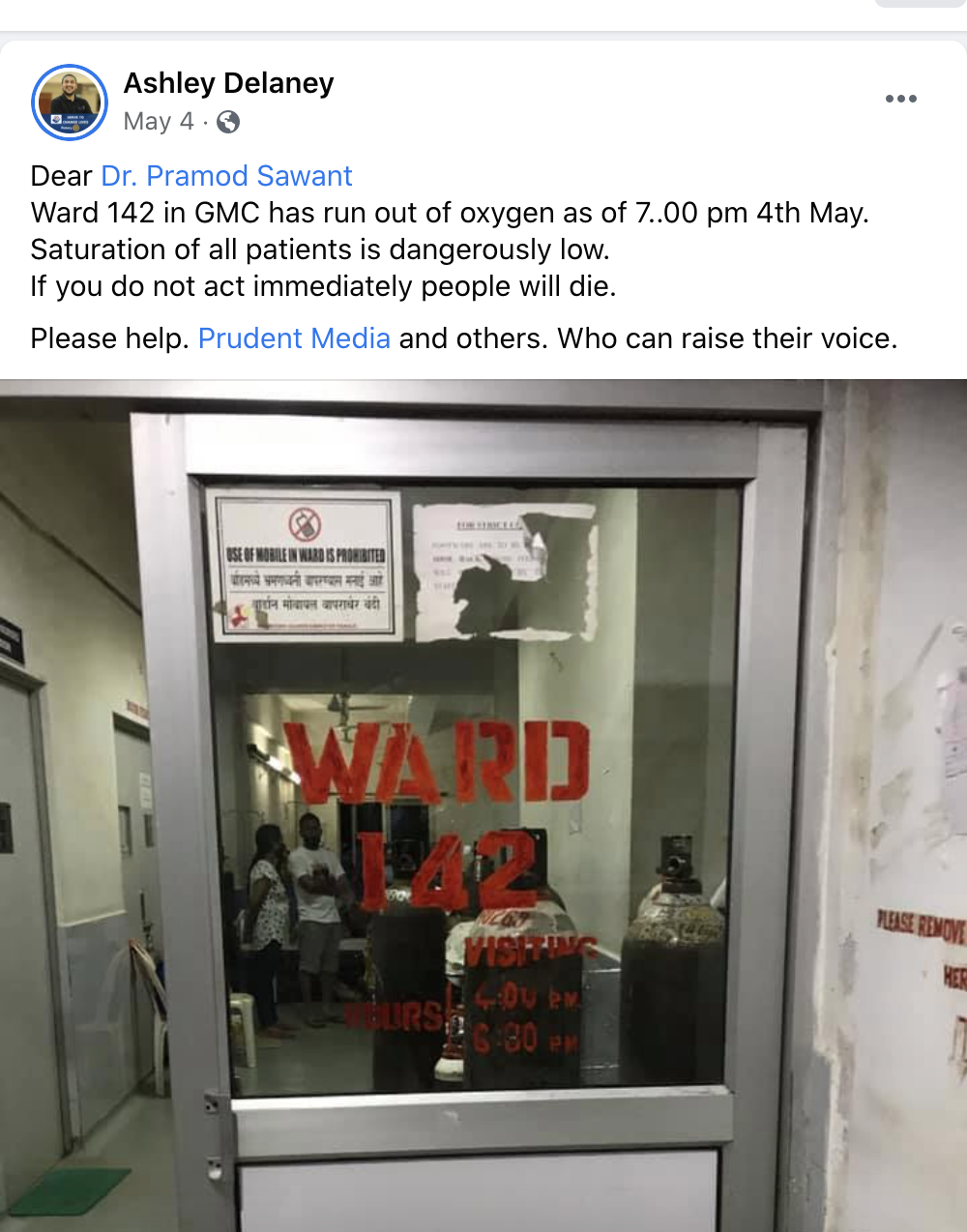
Delaney composed a whistleblowing Facebook post that he showed his 2,700 buddies, tagging Goa’s primary minister, Pramod Sawant: “Ward 142 in GMC has actually lacked oxygen since 7.00 pm fourth May. Saturation of all clients is precariously low. If you do not act right away individuals will pass away.” The post went viral. The really next day, Sawant appeared at the medical facility to meet personnel and inform journalism.
An internal examination would later on reveal that on the nights of Might 2 and 3, 23 individuals had actually passed away due to the fact that of a drop in oxygen levels, simply as Delaney stated. (The other deaths were credited to covid-related causes.) Attorneys appearing on behalf of the state federal government at a later hearing declared that the disturbance in the supply had actually happened due to the fact that the tractor bring the oxygen had trouble “maneuvering” on medical facility premises. The tractor was connected to the loss of a minimum of 83 resides in 5 nights
America might appear to be approaching completion of the pandemic, however covid-19 stays a rising disaster in India, with more than 30 million individuals contaminated and more than 400,000 deaths– main figures that numerous think are far listed below the genuine numbers. A most likely situation, the New york city Times reported on Might 25, is that 539 million individuals have actually been contaminated and more than 1.6 million are dead. On June 27, the Wall Street Journal released figures from the University of Washington’s Institute for Health Metrics and Examination, whose modeling likewise recommends that India is undercounting. The institute approximates the death toll at over 1.1 million, or 3 times the main figure.
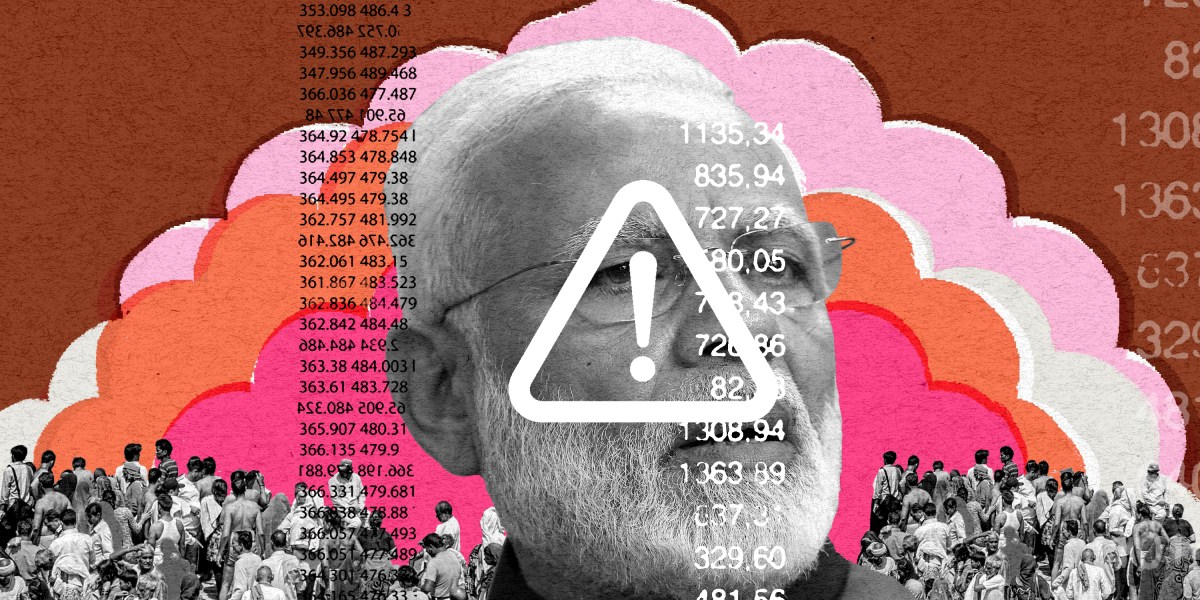
However the crisis was not an inevitable catastrophe. Even the brand-new delta alternative found to be sweeping through the nation was not some awful random mistake. Rather, the disaster that has actually struck countless Indians is the direct result of the federal government’s failures: its failure to prepare ahead by increasing medical facility capability and obtaining medications; its failure to find out contact tracing, gather sufficient information, and purchase vaccines. Even after it ended up being clear that a 2nd wave was unavoidable, the federal government went on with superspreader occasions that served its own political functions– and provided the infection a brand-new chance. And at the center of the crisis– paying little attention to science, relatively declining to observe great recommendations, and appearing worried mainly with hanging on to power at any expense– stands India’s Prime Minister Narendra Modi, a Hindu nationalist whose conceit and underpreparedness have actually cost the nation an enormous quantity.
One crisis triggered another
In March 2020, the early days of the pandemic, Modi revealed a surprise and stringent 21- day nationwide lockdown. At the time India had actually reported simply 360 cases and 7 deaths, according to the WHO. Modi’s choice was praised as proactive, however it was likewise inadequately handled: he provided India’s 1.39 billion individuals less than 4 hours to prepare prior to the lockdown entered into impact, activating the biggest mass migration in the history of the subcontinent given that the Partition of India in1947 Countless day-to-day wage employees– quotes vary from 10 million to 80 million– rushed to go back to their houses in the rural hinterland, however with public transportation closed, lots of were required to stroll numerous kilometers. In its effort to avoid one catastrophe, the federal government triggered another. A humanitarian crisis now unfolded live on India’s TELEVISION screens as almost 1,000 migrants passed away from different lockdown-related causes– traffic mishaps, hunger, and even cops cruelty as officers mercilessly implemented the guidelines. Not just that, however the migration brought the infection, which had actually been focused in city centers, into every corner of the nation.
It wasn’t long prior to Indians might look to favorable news. In April 2020, the Serum Institute of India– the world’s greatest vaccine maker– revealed that it would be producing countless dosages of the Oxford-AstraZeneca vaccine, consisting of as much as 60 million dosages in 2020 and 400 million in2021 Serum produces more than 1.5 billion dosages of vaccines every year, so it wasn’t a stretch to think of that it depended on the job. The business’s billionaire president, Adar Poonawalla, informed Reuters that Modi was ” really carefully” included with the business’s strategies.
However while the prime minister was later on photographed checking out the Serum Institute, the Indian federal government didn’t in fact participate in an arrangement with the producer– nor did it assist it to increase production. In the United States, the federal government had actually introduced Operation Terminal velocity to speed up the federal action to the pandemic; in Britain, Downing Street had actually moneyed the advancement of the AstraZeneca vaccine with an ₤84 million ($117 million) grant and an order for approximately 340 million dosages Modi, on the other hand, didn’t protected vaccines from the maker in his own yard.
India’s loss was the world’s gain: Serum signed agreements with COVAX, a vaccine-sharing collaboration, and other nations consisting of Canada and the UK. It wasn’t till January 2021 that the Indian federal government put its very first order– by which time essentially all of Serum’s stock was promoted. New Delhi later on handled the issue by requiring a freeze on exports till completion of 2021, dealing a serious blow to 92 of the world’s poorest nations, which were counting on Serum for their supply of the AstraZeneca vaccine.
On Might 31, 2020, Indians emerged out of the stringent lockdown to a scenario more precarious than previously. More than 140 million individuals had actually lost their tasks, and the joblessness rate had actually soared from 8%to 26%. The federal government had not utilized the additional time to construct brand-new health centers, much better gear up more than a handful of old ones, or stockpile medication. The lockdown had actually taken the infection to India’s towns, where medical oxygen was a limited product in the very best of situations.
” The concept behind the lockdown was to prepare,” states Ramanan Laxminarayan, the creator and director of the Center for Illness Characteristics, Economics & Policy, a public health company in Washington, DC. “That didn’t appear to have actually occurred.”
Rather, India exported essential materials: two times as much oxygen as the year prior to, and near to 1.1 million systems of the antiviral drug remdesivir, were offered to other nations. As some individuals, consisting of President Trump, promoted hydroxychloroquine as a treatment, India sent out the United States 50 million tablets. And as quickly as Serum was producing vaccines, India exported those. Prior to the anniversary of the pandemic, the federal government distributed more than 66 million dosages to 95 nations in a diplomatic effort it called Vaccine Maitri, or Vaccine Relationship.
” Goa was delegated the pet dogs”
By September 2020, India had the world’s fastest-growing break out of covid-19 in outright numbers, according to the WHO, with in between 5 and 6 million infections. In a nationally telecasted address on October 20, Modi advised individuals not to let their guard down and informed them to use masks– then right away damage his message. “Out of every million, we have around 83 deaths,” he informed a TELEVISION audience. The numbers drew examination, with issues that there was significant undercounting— not a surprise considered that the previous year he had actually been implicated of reducing his own federal government’s report on the joblessness rate due to the fact that it revealed a 45- year high.
Then, in November, a medical professional called Arun Njanappilly Madhavan released a spreadsheet that revealed an inconsistency in between main death figures and the numbers that he and a group of volunteers had actually gathered. They ‘d searched paper obituary notifications and TELEVISION reports in Kerala throughout India’s very first wave. “In Kerala itself around 60 to 70%of deaths were not counted,” states Arun. “Individuals who had hidden conditions or those who had actually evaluated unfavorable prior to passing away were not counted as covid-positive deaths.”
Kerala’s handling of the pandemic is extensively thought about among the couple of brilliant areas in an otherwise miserable landscape. If the undercounting there was so bad, recommended Arun, it was most likely far even worse in other places.
However voices like his were muffled by the federal government’s messaging, which recommended that India had actually in some way outsmarted the infection. The buzz was so strong that even some doctor purchased into it. A Harvard Medical School teacher informed the monetary everyday Mint that “the pandemic has actually acted in a really distinct method India.”
” The genuine damage in undercounting is that individuals will take the pandemic gently,” states Arun. “If allegedly couple of individuals are passing away due to covid, the general public will believe it does not eliminate, and they will not alter their habits.” By mid-December India had actually reached yet another mournful turning point: it tape-recorded its 10 millionth infection. It was just the 2nd nation to do so, after the United States.
The federal government had not utilized the very first lockdown carefully, however December was its possibility to set things right, states Gagandeep Kang, a teacher of microbiology at the Christian Medical College in Vellore, Tamil Nadu. She states that a variety of strategies– increase sequencing, studying public habits, gathering more information, declining approval for superspreader occasions, and beginning the vaccine rollout earlier than prepared– would have conserved numerous lives throughout the now-inevitable 2nd wave.
Rather, she states, the federal government continued its “top-down method,” in which bureaucrats instead of researchers and health-care specialists were making choices.
” We reside in a really unequal society,” she states. “So we require to engage individuals and develop collaborations at a granular level if we are to successfully provide details and resources.”
In December the federal government of Goa let its guard down totally. The state is greatly dependent on tourist, that makes up almost 17%of its earnings. The bulk of the travelers appear in December to commemorate Christmas and New Year on sandy beaches with raves and fireworks.
Vivek Menezes, a Goan reporter, states that the state’s track record as “the location to be” had actually not faded throughout the pandemic. “It’s the location for India’s rich and for Bollywood, and for that reason it’s the location for India,” Menezes states. The pandemic had actually kept foreign travelers from checking out, however domestic holidaymakers gathered. Some states, such as Maharashtra, had actually positioned limitations at their borders; others, like Kerala, had a rigorous policy of contact tracing. In Goa, visitors didn’t even need to reveal an unfavorable covid test. And the state’s masking policy extended just to health-care employees, visitors to health-care centers, and individuals revealing signs. “Goa was delegated the pet dogs,” states Menezes.
The world’s biggest superspreader
India began 2021 having actually signed up almost 150,000 deaths. Just then, in January, did the federal government location its very first vaccine order, and it was for a shockingly low quantity– simply 11 million dosages of Covishield, the Indian variation of the AstraZeneca vaccine. It likewise bought 5.5 million dosages of Covaxin, an in your area established vaccine that has yet to release effectiveness information. Those orders fell far except what the nation in fact required. Subhash Salunke, a senior consultant to the independent Public Health Structure of India, approximates that 1.4 billion dosages would have been needed to totally immunize all qualified grownups.
On January 28, in an address to the World Economic Online Forum in Davos, Modi stated that India had actually “conserved mankind from a huge catastrophe by including corona efficiently.” His federal government then provided the consent for the Kumbh Mela, a Hindu celebration that draws in squashing crowds of countless individuals to the holy city of Haridwar in the northern state of Uttarakhand, which is well-known for its temples and expedition websites. When the state’s previous chief minister recommended that the celebration must be “symbolic” this year offered the situations, he was fired.
A senior political leader in the prime minister’s Bharatiya Janata Celebration informed the Indian publication The Caravan that the federal government had its eye on the upcoming state elections and didn’t wish to lose the assistance of spiritual leaders. As it ended up, the Kumbh wasn’t simply any superspreader occasion– with a reported 9.1 million individuals in presence, it was the world’s biggest superspreader occasion. “Anybody with a standard book on public health would have informed you this was not the time,” states Kang.
The Indian federal government just positioned its very first vaccine order in January 2021, after having actually signed up almost 150,000 deaths. Even then, it was for a shockingly low quantity–11 million dosages of Covishield and 5.5 million dosages of Covaxin for a nation of 1.3 billion.
In February Salunke, the general public health professional, was operating in an agrarian district in the western state of Maharashtra when he observed that the infection was transferring “much faster” than in the past. It was impacting whole households.
” I felt we were handling a representative that had actually altered or appeared to have actually altered,” he states. “I began to examine.” Salunke, it now ends up, had actually discovered one anomaly of a version that had actually been discovered in India the previous October. He believed that the version, now referred to as delta, will run widespread. It did. It is now in more than 90 nations.
” I went to all those who are accountable and those who matter– whether district level authorities or bureaucrats at the main level, you call it. Everybody who I understood I instantly shared this info with,” he states.
Salunke’s discovery does not appear to have actually impacted the main reaction. Even as the 2nd wave was speeding up and after the WHO designated the brand-new anomaly “a variation of interest” on April 4, Modi maintained his chaotic schedule ahead of state elections in West Bengal, personally appearing at many public rallies.
At one point he gloated about the size of the crowd he had actually brought in: “In all instructions I see big crowds of individuals … I have actually never ever seen such crowds at a rally.”
” The rallies were a direct message from the management that the infection was gone,” states Laxminarayan of the Center for Illness Characteristics, Economics & Policy.
The 2nd wave filled healthcare facilities, which rapidly lacked beds, oxygen, and medication, requiring gasping clients to wait– and after that pass away– in houses, in parking area, and on walkways Crematoriums needed to construct makeshift pyres to stay up to date with the need, and there were reports that the profusion of ash wandered up until now it stained clothing a kilometer away. Numerous bad individuals could not even manage to spend for funeral rites and immersed the bodies of their liked ones straight into the River Ganges, which led numerous remains to clean up on the banks in a number of states. Together with these apocalyptic scenes came the news that lethal fungal infections were frustrating covid clients, likely as an outcome of lower infection control and overreliance on steroids in dealing with the infection.
Turmoil continues; Delta spreads
And all along, there has actually been Modi. The prime minister had actually been the face of India’s battle versus the pandemic– actually: his headshot appears plainly on the certificate provided to individuals who get their vaccine. After the 2nd wave, his early triumphalism was buffooned and his absence of readiness derided commonly. Ever since, he has actually gone mainly missing out on from the general public eye, leaving it to associates to put the blame in other places, most significantly– and improperly– on the federal government’s political opposition. As an outcome, Indians have actually been delegated deal with the greatest nationwide crisis of their life time by themselves.
This desertion has actually developed a sense of friendship amongst some groups of Indians, with lots of utilizing social networks and WhatsApp to assist each other out by sharing info about health center beds and oxygen cylinders. They have actually likewise arranged on the ground, dispersing meals to those in requirement.
” The [BJP] rallies were a direct message from the management that the infection was gone.”
Ramanan Laxminarayan, the Center for Illness Characteristics, Economics & Policy
However the management vacuum has actually likewise produced a big market for profiteers and fraudsters at the greatest levels. In Might, opposition political leaders implicated a leader of the judgment BJP celebration, Tejaswi Surya, of participating in a vaccine commission rip-off. And the health minister of Goa, Vishwajit Rane, was required to reject claims that he played a part in a fraud including the purchase of ventilators. Even the prime minister’s signature covid relief fund, PM Cares, came under fire after it invested Rs 2,250 crore (over $300 million) on 60,000 ventilators that medical professionals later on grumbled were malfunctioning and ” too dangerous to utilize.” The fund, which brought in a minimum of $423 million in contributions, has actually likewise raised issues about corruption and absence of openness.
An effective vaccination program may have assisted eliminate the memory of the string of errors, however under Modi it has actually just been one technocratic error after another. At the end of Might, with far less vaccines in hand than it requires, the federal government revealed strategies to begin blending dosages of various vaccine types. And at the height of the 2nd wave, it presented Co-WIN, an online reservation system that was necessary for anybody under 45 who was attempting to get immunized. The system, which had actually been under analysis for months, was dreadful: not just did it instantly omit those who do not utilize computer systems and mobile phones, however it was likewise struck by bugs and overwhelmed by individuals desperate to get defense.
And After That there’s expense. While the federal government covered the expense of vaccination for health-care personnel, frontline employees, and those over 45, it anticipated individuals in between the ages of 18 and 44 to spend for their own shots. India was the only significant nation to hand down this expense to the general public. The majority of paid around Rs 900 ($12) for one shot, however some reported being charged as much as Rs 1800 ($25), a huge amount in a nation where 134 million individuals reside on less than $2 a day. In yet another unmatched relocation, the federal government informed private states that it depended on them to acquire vaccines for the under-45 s. “This was another googly,” states Laxminarayan, who called the federal government’s choice “strange.” India was among just 2 nations worldwide to embrace this design– the other being Brazil, which has actually likewise signed up numerous countless deaths.
The vaccination strategies were so impractical and unreasonable that the Supreme Court weighed in on Might 31, informing the federal government to “see what’s occurring throughout the nation.”
The court explained a few of the federal government’s actions as “approximate and illogical” and required a “fresh evaluation of its vaccination policy.” In early June, the federal government reacted to the rebuke by consenting to acquire vaccines for everybody who is qualified and provide them to the states totally free. In order to get a slot, numerous Indians still have to gain access to Co-WIN, the error-prone online service. It’s the sort of turmoil that they do not require more of– however continue to deal with.
What the next wave appears like
In early Might, Ashley Delaney, the Goa Medical College whistleblower who experienced the over night oxygen failures, discovered yet another client who required his assistance. Sumita Datta, an assistant teacher of economics, had actually been confessed to the healthcare facility with covid however was left ignored for around 14 hours.
” I was wandering in and out of sleep, however none of the personnel troubled with me,” she states. Delaney observed Datta and provided her something to consume. He likewise took her for her tests, even as his father-in-law’s condition degraded.
On May 23, Delaney’s father-in-law passed away of covid-19 Datta, who is 38, endured, although she was detected with covid-related pneumonia. A CT scan revealed that more than 50%of her lung tissue was contaminated. 6 days later on she was released, however she was bedridden for 2 more weeks with chest discomforts, a quick pulse, and basic fatigue.
Today, India’s 2nd wave has actually mainly decreased. The hazard is far from over. A variation of the delta version referred to as delta plus, initially reported on June 11 and stated to be a lot more transmissible, has actually currently been spotted in 12 states. And since June 27 just 4%of Indians were completely immunized, according to a Bloomberg research study.
Now India’s health-care professionals have actually begun cautioning of a 3rd wave that might come as early as September. Salunke is amongst those who think that it will strike those under 18 which health-care employees should be offered the specialized training needed to take care of pediatric clients on ventilators. To conserve lives, the Indian federal government needs to do more of whatever, he states, consisting of getting more individuals immunized and acquiring more drugs for the quickly increasing variety of fungal infections.
” We need to have a prepare for till completion of December 2021, and after that we need to get ready for as much as 2022,” he states. “This will not disappear for a minimum of the next 2 years.”
On The Other Hand, in Goa, Datta is still shaken. When she went back to work after weeks in bed, she discovered herself not able to focus for more than 20 minutes at a time. 3 days later on she was house in bed once again. She states she is “frightened” about the future of the pandemic in India and feels captured at the center of a web of errors and bad moves. Feeling powerless, she questions: “What do we do?”
This story belongs to the Pandemic Innovation Job, supported by the Rockefeller Structure.


No comments:
Post a Comment